Is Tipping a Personal Chef Expected in Brazil?
No — tipping a personal chef in Brazil is not expected, and you will not create any awkwardness or disappointment by not tipping. Unlike in the United States, where service industry workers often depend on gratuities to reach a living wage, Brazilian personal chefs charge a service fee that represents their actual labour cost. The tip is a bonus on top of a complete transaction, not a mechanism that fills a structural income gap.
This is an important distinction. When you pay a personal chef's service fee in Brazil, you are paying the full market rate for their work. The chef has agreed to this rate voluntarily and built their business around it. A tip adds warmth to the interaction — it does not correct an imbalance.
Brazilian restaurant culture does include a 10% serviço charge added to most bills, which has contributed to a general sense that 10% is a baseline expectation in service contexts. For personal chefs, however, this charge is not part of the structure — there is no built-in serviço to add or omit.
When Does a Tip Make Sense?
A tip is a gesture of genuine appreciation — and it makes most sense when the experience genuinely exceeded your expectations. If the chef produced a meal that surprised and delighted you, handled a complex dietary situation with grace, arrived on time and left a kitchen cleaner than they found it, and made the evening feel effortless — a tip is a natural way to acknowledge that extra quality.
Events with an elevated emotional weight are another natural context: a proposal dinner where everything had to be perfect, a birthday celebration that felt unforgettable, a corporate dinner that closed a deal or strengthened an important relationship. In these moments, the chef's contribution to the outcome is significant and a tip is a proportionate acknowledgment.
Conversely, for a routine weekly meal prep session where the chef delivered exactly what was agreed at a fair price — no exceptional difficulty, no above-and-beyond effort — a tip is lovely but there's no social expectation. Many clients tip occasionally (at Christmas, after a particularly beautiful meal) rather than systematically.
Pro Tip
The question to ask yourself is not 'am I supposed to tip?' but 'did this experience genuinely exceed what I paid for?' If the honest answer is yes, a tip is the right response. If the experience was exactly what you expected and paid for, a warm thank-you is complete.
How Much to Tip a Personal Chef in Brazil
The established informal norm for tipping a personal chef in Brazil, when a tip is given, is 10–15% of the service fee. This excludes ingredient costs — you tip on the labour component only, not the grocery bill.
In practice: if a chef's service fee for a dinner for six was R$900, a 10% tip would be R$90 and a 15% tip would be R$135. These are meaningful numbers that communicate genuine appreciation without feeling disproportionate to either party.
For extraordinary circumstances — a chef who drove through a São Paulo downpour to arrive on time, one who beautifully handled a last-minute allergy discovery, or who prepared a technically complex menu under challenging conditions — the 15–20% range is entirely appropriate and will be deeply received.
There is no norm for tipping above 20%. Brazilian culture does not have the same tipping escalation that exists in North America. A 20% tip for exceptional work is already a generous, meaningful gesture.
✓Standard appreciation: 10% of service fee
Appropriate for a great experience that met your expectations with warmth and professionalism.
✓Above-expectations: 15% of service fee
When the chef delivered something that genuinely surprised and delighted you.
✓Extraordinary circumstances: 15–20% of service fee
For exceptional handling of challenges, highly emotional events or a truly unforgettable meal.
✓No tip necessary: 0%
For routine sessions that met your brief without exceptional difficulty. A warm thank-you is complete.
How to Tip: Cash, Pix or Platform?
In Brazil, the most common and preferred tipping method for personal chefs is cash in hand or a direct Pix transfer at the end of the event. Both are immediate, private and require no intermediary platform to process. A Pix transfer is particularly elegant: you can send it while the chef is cleaning up, with a brief message of thanks attached.
If you booked through a platform like myChef, check whether the platform includes a tip option at the end of the booking. Some platforms have built a tipping flow into the post-event experience, which makes it simple and ensures the chef receives 100% of the gratuity (platforms that facilitate tipping typically pass it through without a fee). If the platform doesn't include this option, Pix or cash are the direct alternatives.
What you want to avoid is promising a tip and not delivering it. If you tell the chef at the end of the evening 'I'll transfer you a tip later,' follow through the same night or the next morning. A forgotten tip is not a neutral outcome — it's a small disappointment on top of what may have been an excellent experience.
Other Ways to Show Appreciation
A tip is one form of appreciation — but for personal chefs in Brazil, it is not the most impactful. A detailed, specific, enthusiastic review on the platform where you booked is arguably more valuable, because it directly influences the chef's ability to attract new clients. A review that says 'Chef Maria prepared the most stunning moqueca I've ever eaten outside of Salvador, handled my husband's shellfish allergy with complete professionalism and left our kitchen spotless' does more for her livelihood than a R$100 tip.
A referral to a friend or colleague is equally powerful. Personal chefs in Brazil build a significant portion of their business through word-of-mouth, and a referral from a satisfied client carries the same weight as five new reviews. If you know someone who would love the experience, make the introduction directly.
For chefs you book regularly for meal prep or recurring dinners, a Christmas bonus (gorjeta de natal) is a warm Brazilian tradition that many clients extend to domestic workers and service professionals in December. Equivalent to one week's service fee is a common norm, though any gesture of end-of-year appreciation is warmly received.
Tipping Assistants and Support Staff
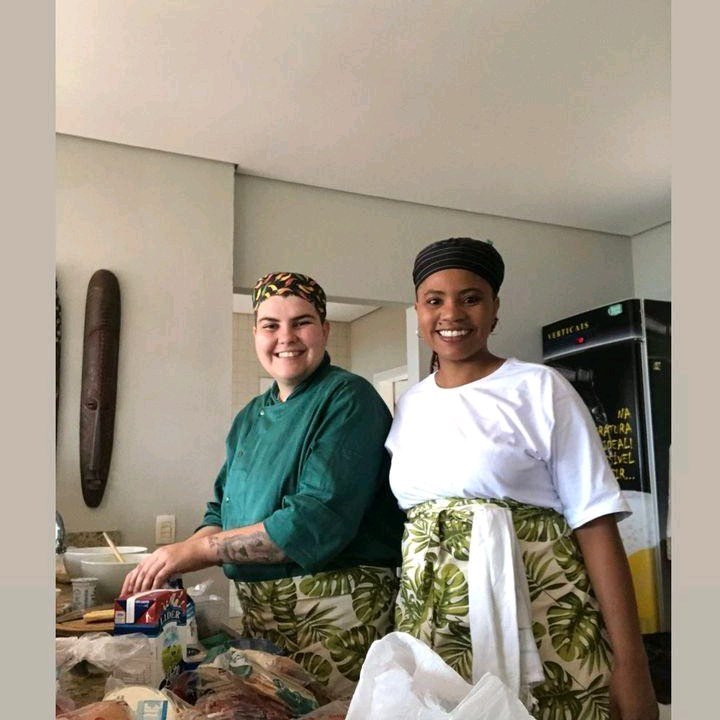
For larger events, a personal chef may bring an assistant (ajudante de cozinha or commis) who handles prep work, cleaning and logistics. If an assistant was present and contributed meaningfully to the quality and smoothness of the event, it is a kind gesture to offer them a separate tip.
The norm is smaller than the chef's tip — R$20–R$50 is appropriate for a standard event, more for a complex all-day event. If you're not sure whether an assistant contributed significantly, you can simply give the full tip to the chef and ask them to distribute it. Experienced chefs do this fairly as a matter of professional culture.
Importantly: never tip the assistant more than the chef, or give the assistant a tip while ostentatiously not tipping the chef. The hierarchy of acknowledgment should mirror the hierarchy of responsibility.