How Restaurant Pricing Really Works
A mid-range restaurant meal in a major Brazilian city like São Paulo or Rio de Janeiro runs between R$80 and R$180 per person for food alone. Add a glass of wine (R$35–R$80), sparkling water (R$15–R$25), a couvert you didn't ask for (R$15–R$30), and a 10–15% service charge, and your actual spend per head climbs to R$150–R$320 before anyone's had dessert.
Fine-dining establishments in neighborhoods like Jardins, Itaim Bibi, or Leblon push these numbers considerably higher. Tasting menus with wine pairings regularly land between R$600 and R$1,500 per person — and that excludes valet parking, a taxi home, and any wait at the bar while your table is 'almost ready.'
The hidden cost restaurants rarely advertise is time: researching, booking, commuting, waiting, and returning. For a group of four, a restaurant dinner can consume three to four hours of everyone's evening, often ending when energy is lowest.
Pro Tip
Always check whether a restaurant's published price includes the 10% service charge and couvert before comparing it to a chef quote.
How Personal Chef Pricing Is Structured
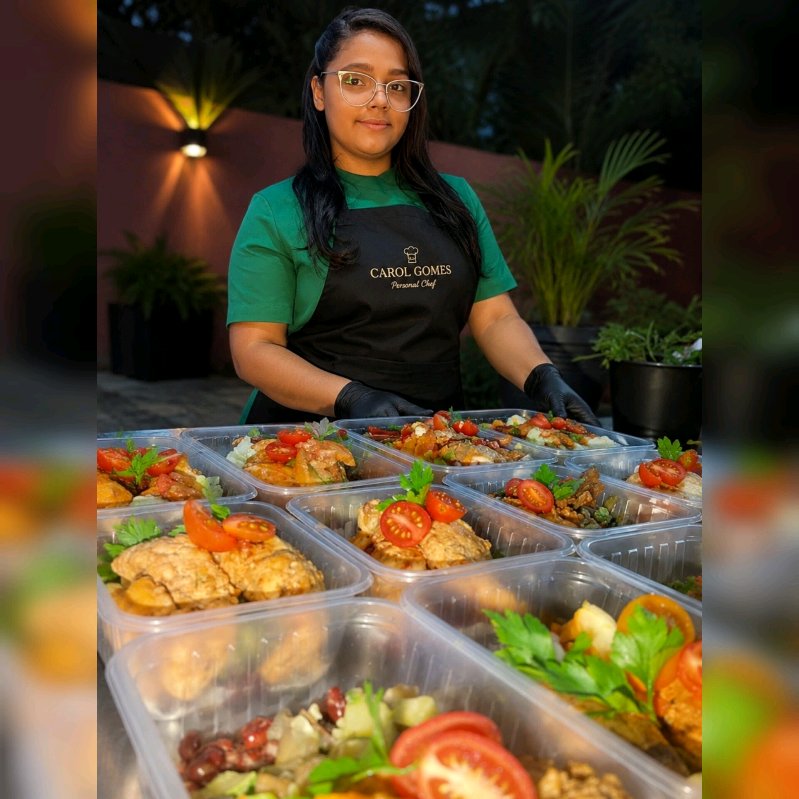
A personal chef in Brazil typically charges a service fee plus ingredients. The service fee covers planning, shopping, cooking, plating, and cleaning up the kitchen. Ingredients are usually billed at cost or with a small administration markup of 10–15%.
For a private dinner for two, total costs in 2026 typically range from R$350 to R$700 per person, depending on menu complexity and the chef's seniority. For a group of six to eight, the per-person cost drops to R$200–R$450, because the chef's service fee is distributed across more plates.
What that price buys: a fully customized menu, shopping done for you, your kitchen left spotless, and the entire evening spent at your own table — no waiting, no neighboring tables, no noise.
✓Request an itemized quote
Ask the chef to separate service fee from ingredient estimate so you can compare apples to apples.
✓Clarify what's included
Confirm whether the quote covers setup, table service, and cleanup or just cooking.
✓Ask about travel fees
Chefs outside your neighborhood may add a travel surcharge of R$30–R$80.
✓Agree on a wine policy
Most chefs allow you to provide your own wine, saving the 200–300% restaurant markup.
The Real Cost Comparison: Scenario by Scenario
Scenario 1 — Romantic dinner for two: A good São Paulo restaurant like those in Vila Madalena or Pinheiros costs R$300–R$600 all-in for a couple (food, drinks, service). A personal chef for the same occasion runs R$500–R$900 all-in, but includes a fully bespoke menu, your own wine at retail prices, and zero commute.
Scenario 2 — Dinner party for eight: Eight people at a quality restaurant will spend R$2,400–R$4,000 total. A personal chef for eight, with a thoughtfully built menu and your own cellar, typically runs R$1,800–R$3,200 — often less than the restaurant, and with a meaningfully better experience at home.
Scenario 3 — Tasting menu / special occasion: A tasting menu restaurant in São Paulo or Rio charges R$600–R$1,500 per person. A chef delivering a comparable six-course experience at home costs R$500–R$1,000 per person — saving R$100–R$500 per guest while giving you total privacy.
What Restaurants Give You That Chefs Can't
Restaurants offer an atmosphere that is purpose-built for dining: professional sound design, curated lighting, a full service team, sommelier expertise, and the social energy of a room full of people enjoying their evening. For some occasions — a first date, a business lunch in a neutral space, a chance encounter with a city's culinary scene — the restaurant setting is genuinely irreplaceable.
Discovery is another restaurant strength. Walking into a celebrated kitchen like D.O.M., Maní, or Lasai puts you in contact with a chef's evolving creative vision in a way that a single in-home dinner can't fully replicate. Restaurants are also zero-prep for the host: you simply show up.
Finally, spontaneity favors restaurants. You can decide at 7 p.m. that you want a great meal at 8:30 p.m. Personal chefs require at least 24–48 hours of planning lead time, and popular chefs book weeks in advance.
What a Personal Chef Gives You That Restaurants Can't
Total customization is the personal chef's defining advantage. Dietary restrictions, ingredient preferences, portion sizes, pacing — everything is designed around your group specifically. No substitution request is awkward; no allergy is a risk. This matters enormously for guests with celiac disease, severe food allergies, or medically prescribed diets.
Privacy and comfort transform the experience. Children can run around. You can pause dinner for an hour. You can dress however you like. You stay in the spaces you know and love, which often leads to conversations that simply don't happen in a restaurant.
The economics of groups strongly favor a personal chef for six or more guests. At a restaurant, every additional guest adds a near-linear cost. With a chef, the service fee stays relatively flat while the ingredient cost scales modestly — making the per-person price progressively more competitive as the group grows.
Pro Tip
For groups of six or more, a personal chef is almost always more cost-effective than a comparable restaurant, particularly when you account for wine brought from home.
Hidden Costs That Shift the Comparison
Restaurant hidden costs include: couvert (R$15–R$30/person), mandatory service charge (10–15%), wine markups (typically 200–350% over retail), valet or parking (R$30–R$80), rideshare to/from (R$40–R$120 per couple), and tip beyond the service charge if the service is exceptional.
Personal chef hidden costs include: travel fee if the chef is far from your address (R$30–R$80), ingredient cost variations if you order rare or seasonal products (truffle, imported seafood), and potentially the cost of renting equipment if your kitchen lacks something the menu requires — though experienced chefs typically come equipped.
One cost comparison that consistently surprises people: wine. A bottle that costs R$80 at a wine shop is typically priced at R$250–R$350 on a restaurant wine list. A group of four sharing three bottles would pay R$750–R$1,050 at a restaurant versus R$240 at cost. That single line item can determine which option is cheaper.
When Each Option Makes More Sense
Choose a restaurant when you want to be discovered somewhere new, when the occasion calls for a neutral third space, when your group is two and you have a last-minute idea, or when you genuinely want to be surrounded by the buzz and atmosphere of a great dining room.
Choose a personal chef when your group is four or more, when someone at the table has a dietary need that complicates restaurant dining, when the occasion demands privacy (proposal, anniversary, intimate birthday), when you want to bring your own wine, or when you want to stretch the evening on your own terms without a kitchen closing around you.
The honest answer to 'which costs more' is: it depends on group size, menu ambition, and how you count your time. For two people at a mid-range occasion, restaurants are often cheaper. For four or more at a special occasion, a personal chef frequently comes out ahead — and almost always wins on the quality of experience.